If you are building or renovating a home, one of the most important — yet most overlooked — decisions is choosing the right material for your water supply plumbing system. The pipe material you choose directly affects the safety of your drinking water, the longevity of your plumbing infrastructure, and your long-term maintenance cost.
The answer, backed by engineering standards and real-world installations across India, is clear: stainless steel pipes are the best material for water supply plumbing systems. In this guide, we break down exactly why — and what to look for when choosing SS pipes in India.
Quick Answer: Stainless steel — specifically Grade 316L (EN 1.4404) — is the best material for water supply plumbing systems. It is corrosion-resistant, does not leach chemicals into drinking water, lasts 50+ years, and complies with BIS and WHO water safety standards. Rhinox India's Triple Press Fit SS pipes are the leading choice for residential and commercial plumbing in India.
Why Your Pipe Material Determines Your Water Quality
Most homeowners assume that once water leaves the municipal supply or overhead tank, its quality is fixed. It is not. The pipe material your plumbing system uses can actively contaminate or preserve water quality before it reaches your tap.
Here is what can go wrong with the wrong pipe material:
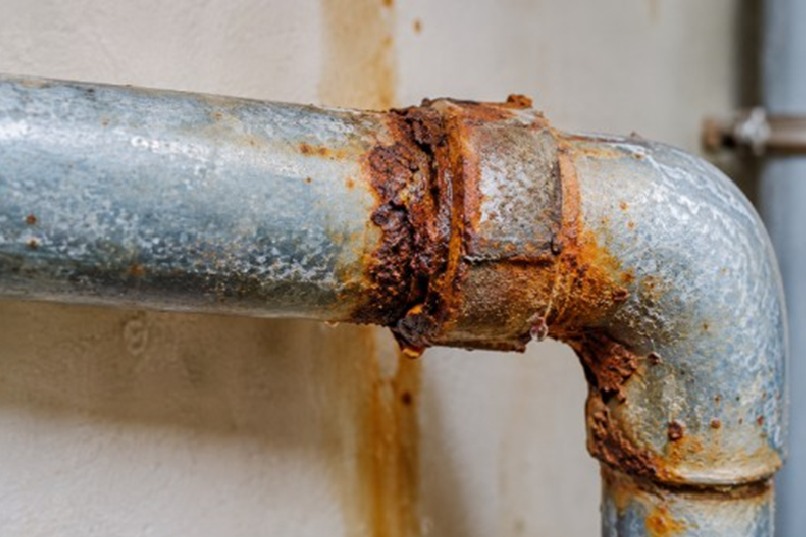
GI (Galvanised Iron) pipes corrode from the inside, releasing rust, iron, and zinc into drinking water within 15–20 years of installation
CPVC and uPVC pipes leach trace plasticisers and chlorine compounds when carrying hot water
Copper pipes, while better than GI, still dissolve trace copper ions into water — a known risk for people with liver conditions
Carbon steel pipes are completely unsuitable for potable water due to rapid internal corrosion
Stainless steel, by contrast, is chemically inert in water. It does not react, leach, rust, or degrade — making it the material of choice for clean, hygienic water delivery in modern plumbing systems across India and globally.
What Makes Stainless Steel the Best Pipe for Drinking Water Supply?
Stainless steel earns its position as the top pipe material for water supply plumbing across 10 performance dimensions:
1. Zero Corrosion — Even in Chlorinated Water
Municipal water in India contains chlorine for disinfection. Chlorine accelerates corrosion in GI and carbon steel pipes, turning them into rust factories within a decade. Stainless steel's chromium oxide passive layer — naturally self-repairing — makes it fully immune to chlorine attack. Grade 316L adds molybdenum, providing extra protection against chloride-induced pitting corrosion in coastal or hard water areas.
2. No Chemical Leaching into Drinking Water
Rhinox India's SS pipes are manufactured from EN 1.4404 (316L) grade stainless steel — the same food-grade material used in pharmaceutical processing and hospital water systems. This grade is certified chemically inert for potable water under NSF/ANSI 61 and complies with WHO Guidelines for Drinking-water Quality. Water passing through Rhinox SS pipes arrives at your tap exactly as it left the source — clean, uncontaminated, and chemically unchanged.
3. Hygienic — Bacteria Cannot Colonise Smooth SS Surfaces
Biofilm — the thin bacterial layer that forms inside pipes — is a major hidden risk in residential plumbing. The ultra-smooth internal bore of stainless steel pipes (Ra ≤ 0.8 μm) gives bacteria almost no surface texture to grip. In contrast, corroding GI pipes develop rough, pitted internal surfaces that become biofilm reservoirs. This makes SS pipes the hygienic standard in hospitals, food processing plants, and now — increasingly — Indian homes and commercial buildings.
4. Handles Both Hot and Cold Water Supply
A complete water supply plumbing system must handle everything from cold storage tank water to hot water from geysers and solar heating systems, which can reach 95°C. Stainless steel maintains full structural integrity from -196°C to 870°C, making it suitable for all water temperatures a residential or commercial plumbing system will ever encounter. CPVC pipes, by contrast, can warp or leach under sustained heat stress above 93°C.
5. High Pressure Capacity for High-Rise Buildings
Modern residential plumbing operates at 2–6 bar pressure. High-rise buildings and commercial setups can push 10–16 bar. Rhinox India's stainless steel pipes have a working pressure rating of up to 16 bar, making them suitable for high-rise apartments, hotels, hospitals, and industrial facilities — applications where CPVC or GI pipes frequently fail.
6. 50+ Year Lifespan — Lowest Lifecycle Cost
GI pipes typically need full replacement within 15–25 years. CPVC degrades from UV exposure and thermal cycling. Stainless steel pipes installed today should still be performing in 2080. When you factor in replacement cost, labour, demolition, and water damage from leaks, the 50+ year lifespan of stainless steel makes it the most cost-effective pipe material over a building's lifetime — not just at point of purchase.
7. Earthquake and Shock Resistant
Stainless steel has a tensile strength of 515–690 MPa (Grade 316L), making SS pipes far more resistant to ground movement, vibration, and mechanical shock than brittle PVC pipes or corroded GI joints. Seismically active regions of India — including parts of Delhi, Gujarat, Uttarakhand, and the Northeast — benefit significantly from the ductility of stainless steel plumbing systems.
8. Lightweight and Fast to Install with Press Fit Technology
Thin-wall stainless steel tubes are significantly lighter than equivalent GI or copper pipes. Rhinox India's exclusive Triple Press Fit (VV) technology allows pipe connections to be completed in seconds without welding, soldering, or open flames — eliminating the need for skilled welders and dramatically reducing installation time and cost on large projects.
9. Fully Recyclable — Low Environmental Impact
Stainless steel is 100% recyclable without quality loss. Unlike PVC, which releases dioxins when incinerated, or GI, which requires hazardous galvanising chemicals, SS pipes have a fully circular lifecycle. For green building certifications like IGBC, LEED, and GRIHA — increasingly required in Indian real estate — stainless steel contributes directly to project scores.
10. No Painting, No Coating, No Maintenance
GI pipes require periodic painting and anti-corrosion treatment. Stainless steel needs zero surface treatment or maintenance throughout its service life. Once installed, a Rhinox India SS plumbing system runs maintenance-free for decades — saving you time, money, and hassle.
SS Pipe vs GI Pipe vs CPVC: Side-by-Side Comparison for Water Supply
Use this comparison to understand which pipe material is best for your water supply plumbing system in India:
| Feature | Stainless Steel 316L | GI Pipe | CPVC Pipe |
|---|---|---|---|
| Corrosion Resistance | Excellent — self-healing passive layer | Poor — rusts internally within 15 yrs | Moderate |
| Drinking Water Safe | Yes (NSF 61 / WHO certified) | No — rust and zinc leach into water | Partial — plasticiser risk in hot water |
| Max Temperature | 870°C | 300°C | ~93°C |
| Max Working Pressure | Up to 16 bar | Up to 10 bar | Up to 16 bar |
| Lifespan | 50–100 years | 15–25 years | 20–30 years |
| Installation Method | Press fit — no welding required | Threaded — skilled labour needed | Solvent cement jointing |
| Maintenance Required | None | Annual anti-corrosion treatment | Periodic UV inspection |
| Recyclable | 100% recyclable | Partially recyclable | Not recyclable — toxic on incineration |
| Lifecycle Cost | Lowest | High — replacement every 15–25 yrs | Medium |
Verdict: For any application involving drinking water supply, stainless steel 316L is the clear winner on safety, longevity, and total cost of ownership.
Which Stainless Steel Grade is Best for Water Supply Plumbing in India?
Not all stainless steel is the same. For water supply plumbing, grade selection matters significantly:
Grade 304 (EN 1.4301): Suitable for most residential potable water applications with chlorine concentrations below 250 ppm. Adequate for interior plumbing in soft-water cities.
Grade 316L (EN 1.4404): The superior choice — adds 2–3% molybdenum which dramatically improves resistance to chloride pitting and crevice corrosion. Recommended for all water supply applications, especially coastal cities, hard water zones, and commercial or high-rise plumbing systems.
Rhinox India manufactures all its stainless steel pipes exclusively in EN 1.4404 (316L) grade — ensuring the highest level of safety and durability for every installation, regardless of water quality or application type.
Important: Many low-cost SS pipes in the market are made from 201 grade stainless steel — a manganese-substituted alloy with significantly lower corrosion resistance and no certification for potable water contact. Always verify the grade certificate when purchasing SS pipes for water supply.
Rhinox India's Stainless Steel Plumbing System for Water Supply
Rhinox India is India's leading manufacturer of Grade 316L stainless steel pipes and press fittings for water supply plumbing systems. Every component in the Rhinox system is built around three core principles: hygiene, reliability, and installation ease.
SS Pipes — Precision Engineered for Zero-Leak Water Supply
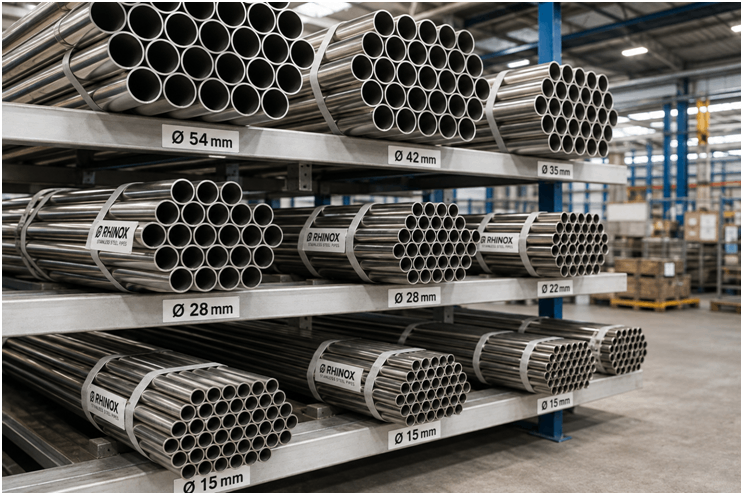
Rhinox stainless steel pipes are manufactured from EN 1.4404 (316L) material with precision cold-drawn forming. Every pipe undergoes rigorous hydraulic pressure testing, eddy current testing, and full annealing to ensure consistent wall thickness and zero-defect seams. Available in standard sizes from 15mm to 108mm OD, covering all residential and commercial water supply requirements.
Triple VV Press Fittings — No Welding, No Leaks
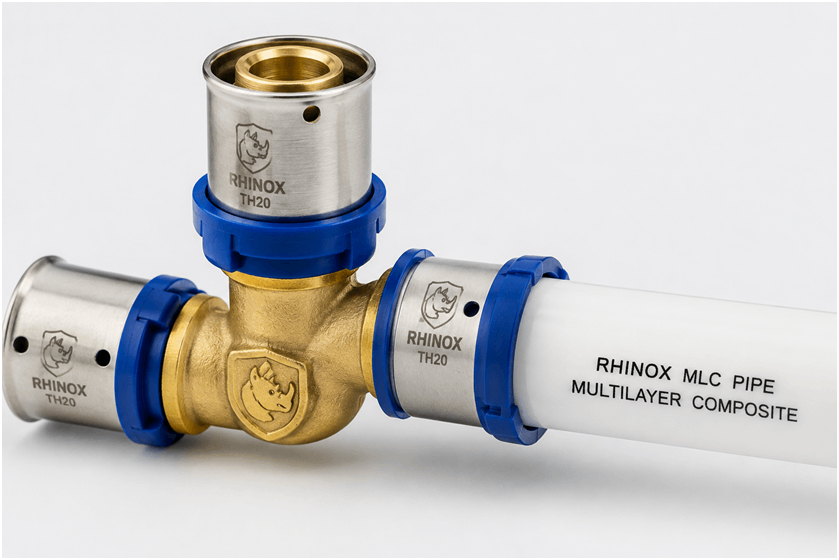
The Rhinox Triple Press (VV) fitting system uses a world-patented three-jaw compression mechanism that creates a permanent, leak-proof seal in under 4 seconds. No heat, no solder, no flux, no skilled welder required. The triple press geometry distributes sealing force evenly around the pipe circumference, delivering a joint strength that exceeds the pipe wall itself. Ideal for water supply systems in residential buildings, hospitals, hotels, and high-rise complexes.
Double V Press Fittings — Cost-Effective for Standard Residential Plumbing
For standard residential water supply installations, Rhinox's Double V press fittings deliver the same hygienic stainless steel quality with a simplified two-jaw press mechanism. Both systems use the same Rhinox Grade 316L pipe — ensuring full water safety compliance regardless of fitting choice.
Where is Stainless Steel Used in Water Supply Plumbing Systems?
Stainless steel pipes and fittings are suitable for every segment of a building's water supply system:
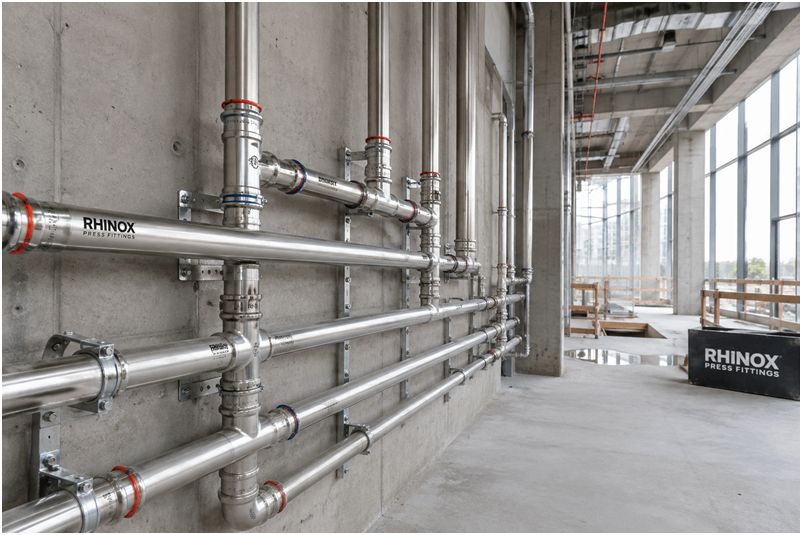
Potable water distribution: Main risers, horizontal distribution, and branch lines carrying drinking water
Hot water supply: From geyser, solar heater, or boiler to bathroom and kitchen fixtures
Cold water supply: From overhead storage tank or pressure pump to all points of use
High-rise building water supply: 16-bar rated risers for multi-storey apartments and commercial towers
Fire fighting systems: Dry and wet riser sprinkler lines — SS is non-reactive with fire suppressants
Industrial water supply: Process water lines in food and beverage, pharmaceutical, and hospitality facilities
Frequently Asked Questions: Stainless Steel for Water Supply Plumbing
Can you use stainless steel pipe for drinking water supply?
Yes — stainless steel is one of the safest materials for drinking water supply plumbing. Grade 316L (EN 1.4404) stainless steel is chemically inert, contains no lead, and does not leach any harmful substances into water. It is certified under NSF/ANSI 61 and complies with WHO Drinking Water Quality Guidelines, making it approved for potable water contact in residential, commercial, and institutional plumbing systems.
What is the best pipe material for drinking water supply in India?
Stainless steel 316L is the best pipe material for drinking water supply in India. It outperforms GI (which corrodes and leaches rust and zinc), CPVC (which can leach plasticisers), and copper (which is expensive and leaches trace copper ions). Stainless steel provides zero corrosion, zero chemical contamination, and a 50+ year service life — making it the highest-performing and most cost-effective long-term choice for Indian water supply systems.
Which is better for water supply — SS pipe or copper pipe?
For most Indian applications, stainless steel pipes are a better choice than copper pipes. SS pipes are stronger, more corrosion-resistant in chlorinated municipal water, significantly less expensive (copper is 3–4x higher in cost), and easier to install with press-fit technology. Copper pipes can also leach trace copper into water, which poses a risk for people with liver conditions. Read our full SS vs Copper pipes comparison for detailed analysis.
How long do stainless steel pipes last in a water supply plumbing system?
Stainless steel pipes installed in a water supply plumbing system typically last 50–100 years when the correct grade is used. Grade 316L shows no measurable corrosion even after decades of potable water service. This compares to 15–25 years for GI pipes and 20–30 years for CPVC — making SS the clear lifetime value leader.
What size stainless steel pipe is needed for residential water supply?
For standard residential water supply plumbing, the most common sizes are: 15mm OD (½ inch equivalent) for branch lines to individual fixtures, 22mm OD (¾ inch) for bathroom and kitchen risers, 28mm OD (1 inch) for main distribution lines, and 42mm–54mm OD for building entry mains. Rhinox India supplies the complete range from 15mm to 108mm OD to cover all residential and commercial water supply requirements.
Is stainless steel plumbing approved under BIS standards in India?
Yes. Stainless steel pipes for water supply in India comply with IS 6913 (stainless steel tubes for potable water) and EN 10312 (European standard for stainless steel tubes for water supply). Rhinox India's Grade 316L pipes meet EN 1.4404 material certification and are manufactured to international quality standards validated through hydraulic pressure testing and eddy current inspection.
What is the difference between SS pipe and GI pipe for water supply?
The primary difference is corrosion resistance and water hygiene. GI (Galvanised Iron) pipes have a zinc coating that corrodes within 10–20 years in chlorinated water, releasing rust, iron, and zinc into drinking water. Stainless steel pipes are inherently corrosion-resistant through their chromium oxide passive layer — no coating required. GI pipes need replacement every 15–25 years; SS pipes last 50+ years. For any new water supply installation, stainless steel is the standard recommended by plumbing engineers across India.
Upgrade Your Water Supply Plumbing System with Rhinox India
Rhinox India supplies complete stainless steel water supply plumbing systems — from Grade 316L SS pipes in all standard sizes to Triple VV Press Fittings and full installation support. Whether you are a homeowner, builder, or plumbing contractor, our team will help you select the right specification for your project.
Call us toll free at 1800-120-6232 or write to contact@rhinoxindia.com to discuss your water supply plumbing requirements.