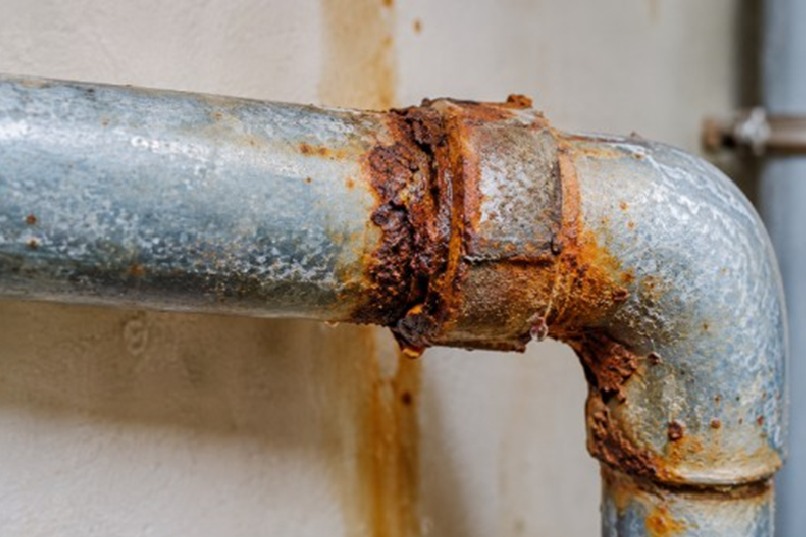
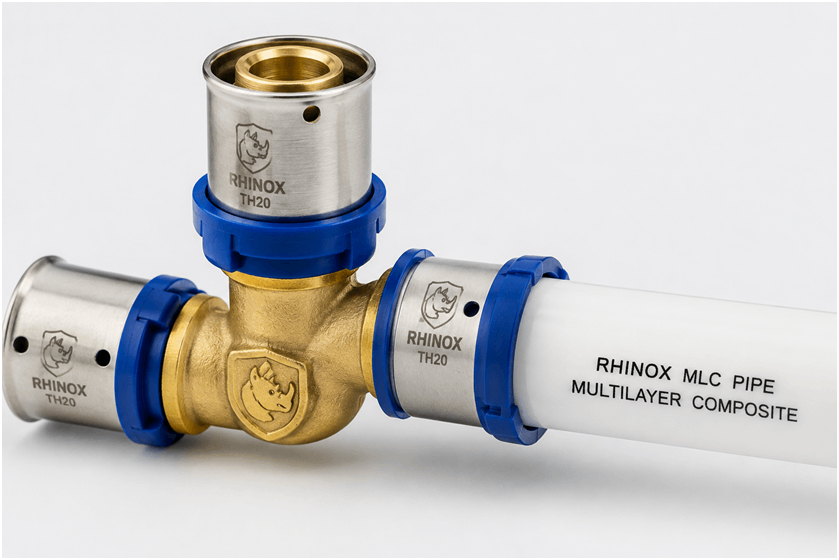
A wrong fitting choice on an MLC pipe network does not show up on day one. It shows up two years later, behind a finished wall, as a damp patch nobody can explain. Brass press fittings are the single component that decides whether that wall stays dry for fifty years or gets opened up for repairs.
This guide covers what brass press fittings are, how they work with MLC pipe, what to check before buying, and how installation actually happens on site.
| Rhinox India manufactures Brass Press Fittings as part of the Rhinox-Wepit system, engineered specifically to pair with Rhinox Multilayer Composite (PEX/PERT) Pipes for flame-free, permanently sealed plumbing installations. |
What Are Brass Press Fittings for MLC Pipes?
Brass press fittings for MLC pipes are mechanical connectors that join multilayer composite pipe sections without welding, soldering, or threading. A hydraulic press tool compresses a stainless steel sleeve around the pipe end, locking it permanently against the fitting body. The result is a sealed, tamper-evident joint completed in seconds rather than minutes.
Why Brass as the Fitting Material?
Brass earns its place in plumbing because it balances strength, workability, and resistance to the water it carries every day. CW617N brass, the grade most manufacturers specify, has decades of proven use in European and Indian plumbing systems.
- Resists corrosion from standing water and chemical treatment
- Machines precisely for tight-tolerance sealing surfaces
- Handles repeated pressure cycling without fatigue cracking
- Costs less than stainless steel for equivalent fitting bodies
- Nickel plating stays external, never touching carried water
- Withstands temperatures up to 95°C without deforming
- Meets ISO 21003 requirements for multilayer piping systems
Brass is not a compromise material here. It is the standard the entire multilayer piping industry, from Europe to India, has settled on for good reason.
How Do Brass Press Fittings for Plumbing Actually Work?
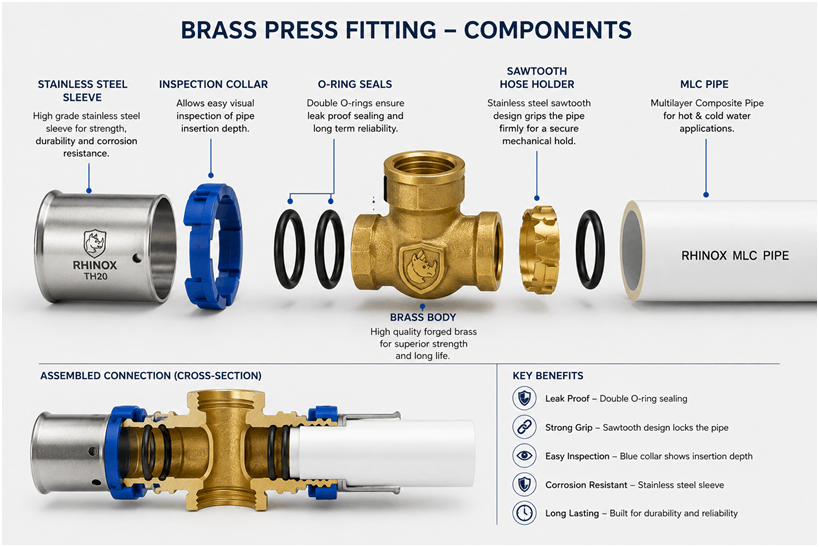
Brass press fittings for plumbing work by mechanically deforming a stainless steel sleeve around the pipe once it is fully inserted into the fitting body. Two pre-lubricated EPDM O-rings inside the fitting create the watertight seal, while a sawtooth-profile hose holder grips the pipe to resist pull-out force. No heat, glue, or threading compound enters the process.
What Happens Inside the Fitting During a Press?
Understanding the mechanics helps explain why a correctly pressed joint rarely fails, while a rushed one almost always does.
- Pipe slides into the fitting until it reaches the internal stop
- Sight holes in the collar confirm full, correct insertion depth
- Press jaw clamps around the marked stainless steel sleeve
- Hydraulic force compresses the sleeve in roughly three seconds
- Sleeve permanently deforms around the pipe and O-rings
- O-rings compress fully, forming the primary watertight barrier
- Sawtooth ridges bite into the pipe wall, locking it mechanically
Once pressed, the joint cannot be pulled apart without cutting it open, which is exactly the tamper-evidence that makes concealed installations safe long-term.
Brass Press Fittings vs. Threaded and Compression Fittings
Brass press fittings outperform threaded and compression fittings on installation speed, leak resistance, and long-term reliability for MLC pipe systems. Threaded joints depend on thread sealant that can degrade, while compression fittings rely on a nut that can loosen under vibration. Press fittings remove both failure points entirely.
Which System Fits Your Project?
Every plumbing job has different priorities. This table breaks down where each connection method actually makes sense.
| Feature | Brass Press Fittings | Threaded Fittings | Compression Fittings |
| Installation time | Seconds per joint | Minutes per joint | Minutes per joint |
| Skill required | Moderate, tool-dependent | High, thread expertise | Moderate |
| Leak risk over time | Very low, permanent seal | Moderate, sealant wears | Moderate, nut can loosen |
| Concealed wall use | Ideal, tamper-evident | Not recommended | Not recommended |
| Tools needed | Hydraulic press jaw | Wrenches, sealant | Wrenches only |
| Best for | New builds, concealed runs | Exposed, serviceable lines | Exposed, adjustable lines |
For any concealed installation, behind tile, under a slab, or inside a wall cavity, press fittings are the only method built for zero future access.
What Should You Check Before Buying MLC Pipe Fittings?
Before buying MLC pipe fittings, check the brass grade, O-ring material, sleeve specification, and standards compliance stated on the datasheet. A fitting without a declared brass grade or a visible batch marking is a red flag, regardless of how polished the packaging looks.
What Does a Quality Fitting Datasheet Include?
A proper datasheet removes the guesswork. If a supplier cannot answer these points directly, that is worth noting before placing an order.
- Confirm the brass grade, ideally CW617N per international standard
- Check O-ring material, EPDM for water and heating systems
- Verify the stainless steel sleeve grade and hardness rating
- Look for ISO 21003 or equivalent multilayer piping compliance
- Ask for the maximum rated pressure and temperature figures
- Request batch traceability and manufacturing origin documentation
- Confirm compatible pipe diameter range for your project
A fitting that checks every box on this list is one you can specify with confidence, on paper and on site.
Rhinox India's Brass Press Fittings publish exact material specifications, including the CW617N body grade, EPDM O-ring construction, and AISI 304 stainless steel sleeve, so specifiers never have to guess.
How Do Brass Press Fittings Pair With MLC Pipes Specifically?
Brass press fittings pair with MLC pipes through matched sizing and a shared pressure and temperature rating, so the weakest point in the system is never the joint. Rhinox's Multilayer Composite (PEX/PERT) Pipes are rated to 10 bar and 95°C, and the brass fittings built for them share that same rating across the full 16mm to 32mm range.
Why Does Matched Sizing Matter This Much?
A fitting and pipe from different systems may look compatible but behave very differently once pressurised.
- Mismatched wall thickness prevents a full, even seal
- Sight holes only work when depth markings actually align
- Pressure ratings must match on both the pipe and fitting
- Sawtooth profiles are cut for specific pipe wall thickness
- Third-party certification usually covers matched system pairs only
- Mixing brands voids most manufacturer warranty coverage instantly
- Field failures often trace back to mismatched component sourcing
Buying pipe and fittings from the same manufacturer is not brand loyalty for its own sake. It is the simplest way to guarantee the joint behaves exactly as tested.
How Do You Install Brass Press Fittings the Right Way?
Install brass press fittings by cutting the pipe square, deburring both edges, marking the insertion depth, pushing the pipe fully into the fitting, and pressing with a calibrated jaw for the full cycle. Skipping any single step is the most common cause of a failed joint discovered only during pressure testing.
What Are the Most Common Installation Mistakes?
Most failures trace back to rushing, not to the fittings themselves. These mistakes show up repeatedly across job sites.
- Cutting the pipe at an angle instead of a square edge
- Skipping the deburring step, which damages internal O-rings
- Failing to insert the pipe fully to the internal stop
- Using an incompatible or worn press jaw on the fitting
- Interrupting the press cycle before it completes fully
- Not verifying insertion depth through the sight holes
- Skipping pressure testing before closing up the wall
Ten seconds of care at each step prevents years of hidden risk. That trade is not close.
Are Brass Press Fittings for Plumbing Safe for Drinking Water?
Yes, brass press fittings for plumbing are safe for drinking water when the nickel plating stays external and the fitting is certified for potable use. The brass body itself never contacts the water directly in a properly designed fitting, since the internal surface and O-ring seal manage that contact instead.
What Certifications Should You Look For?
Certification claims vary widely across suppliers, so verify rather than assume.
- Confirm compliance with ISO 21003 for multilayer piping systems
- Check for lead-content limits appropriate to potable water use
- Ask whether the fitting has undergone third-party water testing
- Review batch testing records for hydraulic pressure performance
- Confirm EPDM O-rings carry drinking water safety certification
- Verify the manufacturer discloses full material composition openly
- Look for consistency between marketing claims and datasheet specs
The ISO 21003 standard governs multilayer piping systems for hot and cold water inside buildings, covering both the pipe and the fittings that connect it.
Frequently Asked Questions
What size brass press fittings work with MLC pipes? Most systems, including Rhinox's, cover pipe diameters from 16mm to 32mm for standard residential and commercial runs. Always match fitting size exactly to the pipe diameter specified in your project drawings.
Can brass press fittings be reused after pressing? No. Once pressed, the stainless steel sleeve permanently deforms around the pipe, making the joint tamper-evident and non-reusable. A new fitting is required for any rework.
Do brass press fittings need special tools to install? Yes, a calibrated hydraulic press jaw matched to the fitting's pressing profile is required. Standard wrenches or hand tools cannot achieve the compression needed for a proper seal.
How long do brass press fittings last? When installed correctly within rated pressure and temperature limits, brass press fittings typically match the 50-year service life of the MLC pipe system they connect.
Are brass press fittings flame-free to install? Yes. The entire installation relies on mechanical pressing, with no soldering, welding, or open flame involved, making it suitable for occupied buildings and fire-sensitive sites.
What happens if a brass press fitting is not fully pressed? An incomplete press typically produces a visible leak during pressure testing, which is why testing before closing up walls is a non-negotiable step in every installation.
The Bottom Line
Brass press fittings are the connection point that determines whether an MLC pipe system delivers on its fifty-year promise or fails quietly behind a wall. Matched sizing, verified certification, and correct installation technique matter more than brand marketing claims. Choose a fitting with a stated brass grade, tested O-rings, and a pressure rating that matches your pipe exactly.
Explore Rhinox India's Brass Press Fittings alongside the matched Multilayer Composite Pipes, or call the toll-free technical support line at 1800-120-6232 to get sizing help for your project.