

Compressed air often gets treated as “just air,” yet it is one of the costliest utilities in a factory. An IGES–TERI study of Indian plants put it at 5 to 35% of manufacturing electricity use, and leaks alone often waste 20 to 30% of compressor output. The pipework decides how much of that cost you lose. Well-planned compressed air piping systems cut waste before the compressor ever speeds up.
This guide covers layout, pressure drop, pipe materials, joints, condensate and where press-fit systems fit.
Quick Answer: Compressed air piping systems work best when they are sized for low pressure drop (under 10% of compressor discharge pressure), laid out as a loop, built from corrosion-resistant material, joined with few leak-prone connections and drained of condensate. Match pipe and joint to your air quality, oil content and pressure, and confirm every rating with the manufacturer.
How Should You Plan an Industrial Compressed Air Distribution System?
Plan the network as a loop main with branches, so air can reach each point from two directions and pressure stays stable. Take branch lines off the top of the header so condensate does not follow the air into tools. Lay pipes with a slight fall toward drain points, add isolation valves to separate zones, and avoid dead ends. Size the main for future machines, because adding load to a tight header raises pressure drop everywhere. An industrial compressed air distribution system is easiest to fix on paper, not above a finished production line.
How Much Pressure Drop Is Acceptable, and How Do You Size the Pipe?
Aim for a total drop below 10% of compressor discharge pressure, from compressor to point of use. Keep main header velocity at about 6 m/s or less. At 7 bar discharge, 10% leaves just 0.7 bar for the dryer, filters, header, branches and hoses combined. Undersized pipe is the usual culprit, and a common rule of thumb says each 2% of pressure drop costs about 1% in compressor energy. Check the small components too. Hoses, filters and regulators sized only by thread size can lose more pressure than the pipe itself.
Which Pipe Material Is Best for Compressed Air?
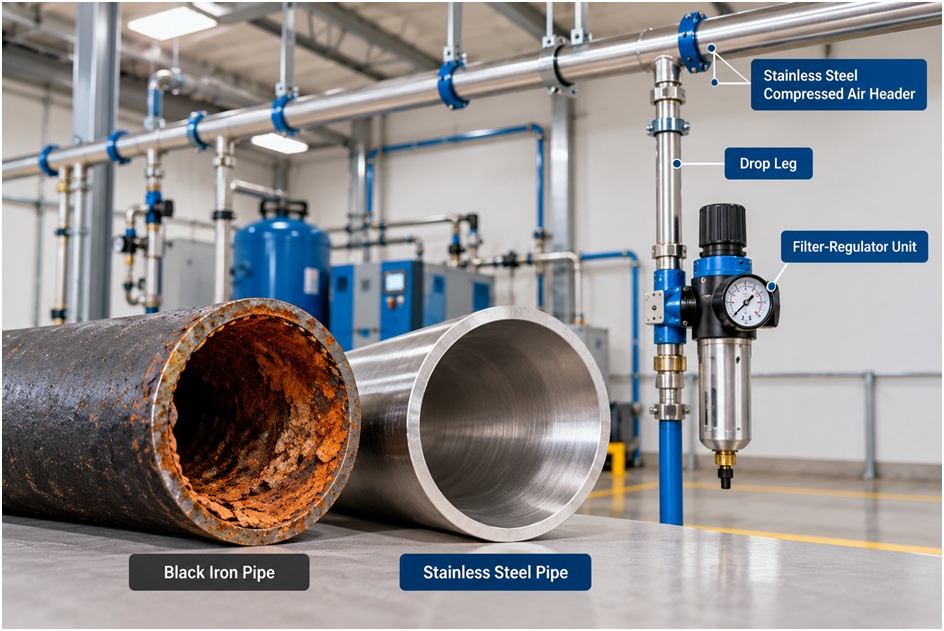
There is no single best material. Match it to air quality, budget and the duty. This is the core of compressed air piping material selection.
| Material | Strength | Watch-outs |
| Black iron / steel | Strong and low cost | Rusts and sheds particles; heavy; needs threading or welding |
| Galvanised steel | Zinc coating slows rust | Some air-system specialists advise against it |
| Aluminium | Light; corrosion-resistant | Harder to modify once installed |
| Stainless steel | Durable; corrosion-resistant; suits oil-free wet air | Heavier; threaded joints tend to leak or seize |
| PVC / CPVC / PEX | Cheap | Do not use; can shatter under pressure |
Why Do Joints Decide Leak Performance?
Because leaks usually start at connections, not in the pipe. Well-maintained systems keep leakage under 5 to 10% of output, while many plants lose 20 to 30%. Threaded joints are the weak point, and stainless threads in particular tend to leak or seize. Welding gives a permanent joint but needs hot work and skilled welders. Press-fit gives a permanent mechanical joint without flame. Fewer threaded joints means fewer places for a slow leak to form. The press-fit installation guide covers the pressing method.
Where Do Rhinox Press-Fit Systems Fit in Compressed Air Piping?
Rhinox lists compressed air among the applications of its Rhinox Press system, and its Double (V) press fittings are described as suited to compressed air systems. The system page lists 16 bar for V-press and 25 bar for VV press fittings. Many plant networks run around 7 bar, but confirm the rating for your air temperature and fitting type. Pair them with Rhinox stainless steel pipes (EN 1.4404, DN15 to DN100) on branches, drops and clean-air lines. Large headers above DN100 need other pipe.
Seal choice matters. Rhinox notes that EPDM suits standard water and heating, while an FPM seal is needed for media containing oil or high temperatures. Compressor oil can carry into the line, so state whether your air is oil-free or lubricated and ask Rhinox to confirm the seal.
How Do You Manage Condensate and Air Quality?
Air cools as it travels, and water condenses out. Drain legs, automatic drains at low points and a correctly sized dryer keep it away from tools. Air quality is graded under ISO 8573-1 for particles, water and oil, so know your required class before you choose the pipe. Stainless suits oil-free wet air, where condensate is acidic.
Maintenance checks that protect efficiency
- Run ultrasonic leak surveys on a regular schedule
- Check drains and filters for clogging or blockage
- Log header pressure to catch drifting demand
- Reduce set pressure only after fixing pressure drop
Frequently Asked Questions
What is the best pipe material for compressed air?
It depends on air quality and budget. Stainless steel, aluminium and copper resist corrosion. Black iron can rust and shed particles. PVC and other plastics should not be used.
How much pressure drop is acceptable in compressed air piping?
Aim for under 10% of compressor discharge pressure from compressor to point of use. Keep header air speed around 6 m/s or lower.
Can press fittings be used for compressed air?
Yes, where the manufacturer lists compressed air and the pressure, temperature and seal suit your system. Rhinox lists compressed air among its press applications. Confirm ratings and seals for your air.
How do I reduce compressed air leaks?
Find leaks with an ultrasonic detector, repair them, reduce threaded connections and avoid running higher pressure than needed. Well-maintained systems keep leakage under about 5 to 10%.
Do compressed air pipes need a slope?
Usually a slight fall toward drain points, with branches taken from the top of the header, so condensate drains instead of reaching tools.
Plan the Network Before the Pipes Go In
Pressure drop, leaks and contamination are all easier to design out than to fix on a running line. Choose material, joints and seals against your air quality and pressure, and get every rating in writing. Send your operating pressure, oil-free or lubricated air, and pipe sizes to Rhinox’s technical team, and ask about design help through its one-stop service.
Explore the range: SS Pipes - V-Press Fittings - VV-Press Fittings - Rhinox Press System


