

A fire system sits idle for years, then has minutes to work perfectly. That makes the pipe specification less about day-one looks and more about what is approved, rated and still sound a decade later. Choosing stainless steel pipes for fire fighting systems comes down to approvals, pressure, seals and size limits.
This guide shows how engineers assess pipe material, what approvals to ask for, and where press-fit stainless steel can fit.
Quick Answer: Stainless steel pipes for fire fighting systems can suit sprinkler and hydrant lines where corrosion resistance and flame-free installation matter. They only qualify when the pipe, fittings and seals carry the approvals your project, insurer and local fire authority require. Check listings, pressure ratings, O-ring material and size limits before you specify.
What Are the Fire Fighting Piping System Requirements in India?
Indian projects generally design to the National Building Code 2016, Part 4 (Fire and Life Safety), with IS 15105:2021 for automatic sprinkler systems and IS 3844 for internal hydrants. The local fire authority must accept the design, and the fire NOC depends on it. Some projects, especially those with international occupants or insurers, add NFPA 13 or insurer standards. The requirement chain runs from code to design to approved components to authority sign-off. A pipe that skips the third step can fail the fourth.
Which Fire Sprinkler Pipe Material Suits Which System?
Black steel remains the usual specification, CPVC is limited to light-hazard wet systems, and stainless steel with press fittings suits selected lines where approvals allow. Tender specifications in India commonly call for steel pipe to IS 1239 or IS 3589. IS 16088 recommends CPVC for wet systems only.
| Material | Where it is commonly used | Watch-outs |
| Black steel (IS 1239 / IS 3589) | Wet risers, hydrants, sprinkler mains | Corrodes inside and out; welding needs hot work; needs painting |
| CPVC (IS 16088) | Wet sprinklers in light-hazard occupancies | Wet systems only; hazard class limits |
| Stainless steel with press fittings | Concealed or corrosion-sensitive sprinkler and hydrant branches | Needs approval for the exact system; size range limits |
Which Approvals Should Stainless Steel Fire Fighting Pipes Carry?
Look for approval of the whole system, meaning pipe, fittings and seals together, for fire-protection service from a recognised body such as UL, FM, VdS or LPCB, plus acceptance from your local fire authority. NFPA 13 expects components to be used within their listing limits, so mixing parts from different systems can void the approval. Ask for the certificate and read its limits for pipe sizes, hazard class and wet or dry service. Quality-system and potable-water certificates matter, but they are different from fire-protection approvals. Rhinox lists sprinkler systems (wet and dry) among the applications of its Rhinox Press system. Confirm the approval status for your project with its technical team before specifying.
How Do Pressure Rating and Seals Affect Fire Systems?
Pressure ratings must cover the highest pressure the system sees, not only duty pressure. Fire pumps can deliver higher pressure at shut-off, and height adds about 1 bar per 10 m. Standard sprinkler components in common US specifications are rated for at least 175 psi (about 12 bar), and higher-pressure systems need components rated above that. Rhinox’s Rhinox Press page lists 16 bar for Double (V) press fittings and 25 bar for Triple (VV) press fittings. Seal material is part of the approval, so do not swap an O-ring without written confirmation. Pump starts and valve closures also cause surges, covered in the water hammer guide.
Why Consider Stainless Steel for Dry and Pre-Action Pipework?
Dry and pre-action pipes hold air and trapped water between tests, which drives internal corrosion in black steel. NFPA 13’s 2025 edition even adds a provision allowing vapor-phase corrosion inhibitors in the air supply of dry and pre-action systems as a way to reduce corrosion. Stainless steel resists that general corrosion, though water chemistry still matters and dry-service approval must be confirmed.
Where flame-free joining helps
- Retrofits in occupied hotels, hospitals and malls avoid hot work
- Concealed ceiling runs need fewer permits and fire watches
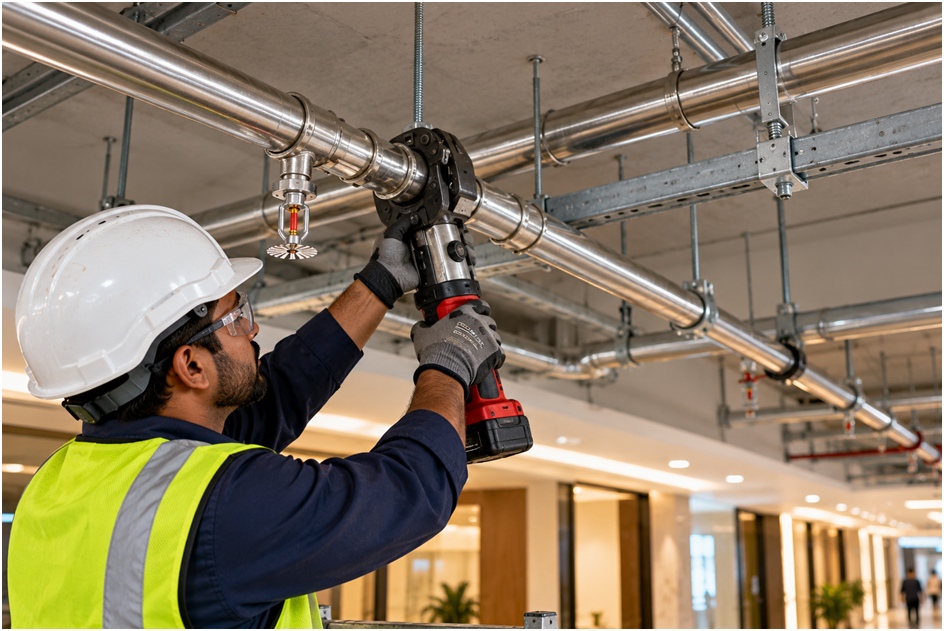
- Press joints are made in seconds by one operator
Where Do Rhinox Stainless Steel Pipes Fit?
Rhinox stainless steel pipes are EN 1.4404 (316L) in DN15 to DN100, which is 15 to 108 mm outside diameter. V press fittings cover 15 to 108 mm, and VV press fittings cover 15 to 54 mm. That suits branches, concealed ceiling runs and smaller mains once approval is confirmed for the project. Large wet-riser and header sizes often exceed 100 mm, so plan other pipe there. Rhinox’s older post on fire fighting pipe basics covers the fundamentals, and the application page lists fire extinguishing among its uses.
Five items to confirm in writing
- Approval certificate for pipe, fittings and seals together
- Permitted pipe sizes, hazard classes and wet or dry service
- Rated pressure against pump shut-off and static head
- Approved O-ring material and temperature limits
- Fire authority or insurer acceptance for this project
Frequently Asked Questions
Can stainless steel pipe be used for fire sprinkler systems?
Yes, where the pipe, fittings and seals are approved for fire-protection service and accepted by the local authority. Check the listing’s limits on hazard class, wet or dry service and size.
What pipe material is used for fire sprinklers in India?
Black steel to IS 1239 or IS 3589 is the common specification. CPVC to IS 16088 is limited to wet systems in light-hazard areas. Other materials need approval.
Are press fit fittings allowed in fire protection systems?
Only products approved for fire-protection service, installed to their listing instructions. Ask the manufacturer for the certificate and check its size and system limits.
Does stainless steel corrode in dry sprinkler systems?
It resists the general corrosion that affects black steel, but water chemistry still matters. Confirm dry or pre-action suitability and approval with the manufacturer.
What sizes do Rhinox stainless steel pipes cover?
DN15 to DN100 (15 to 108 mm outside diameter). V press fittings cover 15 to 108 mm and VV fittings 15 to 54 mm. Larger mains need another pipe and jointing method.
Specify Fire Piping With the Paperwork in Hand
Fire pipe choices are judged years later, on the day a system must perform. Match material, pressure and seals to the system, and keep the approval certificates with the submittal. Send your sizes, pressures and system type to Rhinox’s technical team, who also offer circuit design assistance through its one-stop service.
Explore the range: SS Pipes - V-Press Fittings - VV-Press Fittings - Rhinox Press System


