There is a pipe material quietly taking over modern plumbing installations across India — and most homeowners, builders, and even plumbing contractors have not fully caught up with what it is or why it is changing the way buildings are plumbed. Multilayer composite pipes — also called MLC pipes, PEX-AL-PEX pipes, or composite plumbing pipes — combine the flexibility of plastic with the structural strength of aluminium and the corrosion resistance of modern polymer technology in a single, lightweight, bend-by-hand pipe that installs faster than anything that came before it.
In this complete guide, we cover everything you need to know about multilayer composite pipes — what they are, how they are constructed, where they outperform traditional pipe materials, where they should not be used, and how Rhinox India's MLC composite pipes pair with the complete Rhinox Press system to deliver a faster, cleaner, and longer-lasting plumbing installation for Indian residential and commercial projects.
Quick Answer: Multilayer composite (MLC) pipes are three-layer pipes comprising an inner PEX or PE-RT polymer layer for water contact, a central aluminium layer for structural strength and oxygen barrier, and an outer polyethylene layer for mechanical protection. They combine the flexibility of plastic with the strength of metal — bendable by hand, lightweight, corrosion-proof, and compatible with press fit fittings for flame-free installation. Rhinox India's MLC pipes are manufactured using steam cross-linking under vacuum and are compatible with the complete Rhinox press fitting platform.
What Are Multilayer Composite Pipes (MLC Pipes)?
Multilayer composite pipes — abbreviated as MLC pipes, MLCP, or PEX-AL-PEX depending on the cross-linking method used — are engineered plumbing pipes made from bonded layers of polymer and aluminium. Unlike single-material pipes such as GI (metal only), CPVC (plastic only), or copper (metal only), MLC pipes are a hybrid construction that draws specific performance benefits from each layer in the composite structure.
First developed in Europe in the early 1990s for radiant floor heating applications, multilayer composite pipe technology has since expanded globally into potable water supply, commercial HVAC, solar heating, and compressed air distribution — wherever a combination of flexibility, pressure resistance, corrosion immunity, and installation speed is required.
In India, MLC pipes are rapidly gaining adoption in premium residential construction, hotel and hospitality projects, and concealed plumbing installations where the routing flexibility of composite pipe eliminates dozens of fittings and potential leak points that rigid SS or GI pipe would require.
How Multilayer Composite Pipes Are Constructed — The Three-Layer Structure
Understanding the three-layer construction of MLC pipes explains why they outperform single-material alternatives in so many applications:
Layer 1 — Inner Polymer Layer (PEX or PE-RT)
The innermost layer of an MLC pipe is made from either cross-linked polyethylene (PEX) or polyethylene raised temperature (PE-RT). This is the water-contact surface — the layer that determines the hygiene and chemical compatibility of the pipe with the fluid being transported.
PEX (cross-linked PE): The more common inner layer material. Cross-linking creates a molecular network that dramatically improves the pipe's heat resistance, pressure retention, and resistance to slow crack growth compared to standard polyethylene.
PE-RT (raised temperature PE): An alternative inner layer material with similar performance characteristics to PEX but produced without chemical cross-linking agents — suitable for drinking water contact and widely specified in European health-conscious markets.
Rhinox India's MLC pipes use steam-based cross-linking under vacuum conditions — a precision manufacturing process that ensures uniform cross-linking treatment across the full length and diameter of every coil, regardless of size. This eliminates the inconsistency that can occur in simpler cross-linking processes and delivers predictable, certified performance in every metre of pipe.
Layer 2 — Central Aluminium Core
The central aluminium layer is what makes MLC pipes fundamentally different from pure plastic pipes. The aluminium core contributes three critical performance properties that no polymer layer alone can provide:
Mechanical strength: The aluminium core gives MLC pipes the pressure resistance and structural rigidity of metal — while the outer polymer layers protect the aluminium from corrosion and external damage. This combination allows MLC pipes to handle working pressures that would cause standard PVC or CPVC pipes to fail at elevated temperatures.
Shape memory and bend retention: The aluminium layer gives MLC pipes the ability to be bent and shaped by hand — without a pipe bender — and retain the bent shape permanently. This is the property that makes MLC pipes so significantly faster to install than rigid pipe in concealed and confined routing scenarios.
Total oxygen barrier: The aluminium layer creates a complete barrier to oxygen diffusion through the pipe wall. In closed-loop heating systems — underfloor heating, central heating circuits, solar thermal loops — oxygen ingress through plastic pipe walls causes corrosion of metallic system components (pumps, boilers, radiator valves). MLC pipes eliminate this oxygen ingress entirely, protecting the full system from oxygen-induced corrosion.
Layer 3 — Outer Polyethylene Protection Layer
The outermost layer of the MLC pipe is a high-density polyethylene (HDPE) jacket that protects the aluminium core from external mechanical damage, chemical attack from building materials (cement, plaster, adhesives), and UV degradation in surface-mounted or partially exposed installations. The outer HDPE layer also provides a smooth surface for pipe identification marking — size, pressure rating, manufacturer, and production date — which is mandatory for certified building materials in India.
Adhesive Bonding Layers
Between each of the three primary layers, co-extruded adhesive bonding layers ensure complete delamination resistance across the full operating temperature and pressure range of the pipe. Delamination — where layers separate under thermal cycling or mechanical stress — is the most common failure mode in low-quality composite pipe. Rhinox India's MLC pipes use a multi-stage adhesive bonding process that eliminates delamination risk over the 50+ year service life of the pipe.
MLC Pipe vs Traditional Plumbing Pipes — Complete Comparison
How does multilayer composite pipe performance compare against the pipe materials currently dominating Indian plumbing installations?
| Property | MLC Pipe (Rhinox) | GI Pipe | CPVC Pipe | SS Pipe (Rhinox) |
|---|---|---|---|---|
| Material structure | PEX + Aluminium + PE composite | Galvanised steel | Chlorinated PVC plastic | 316L stainless steel |
| Flexibility | Excellent — bend by hand, holds shape | Rigid — no flexibility | Semi-rigid — limited bending | Rigid — no flexibility |
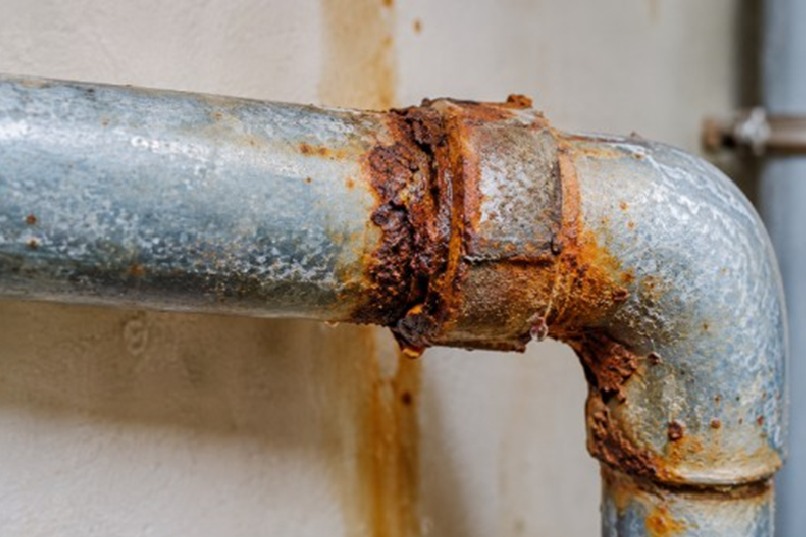
| Corrosion resistance | Excellent — no internal corrosion | Poor — rusts internally | Good | Excellent — self-healing passive layer |
| Max working temp | 95°C continuous / 110°C peak | 300°C | 93°C max | 120°C standard / 200°C high-temp |
| Thermal expansion | Low — aluminium core controls expansion | Low | Very high — causes stress at joints | Very low |
| Weight | Very light — easy handling | Heavy | Light | Light — thin wall tube |
| Oxygen barrier | Yes — complete aluminium barrier | Yes | No | Yes |
| Drinking water safe | Yes — PEX inner layer certified | No — rust and zinc leaching | Partial — plasticiser risk | Yes — NSF 61 / WHO certified |
| Installation method | Press fit — flame-free, fast | Threading — slow, skilled labour | Solvent cement | Press fit — flame-free, fast |
| Fire resistance | Limited — not for fire systems | Good | Poor — melts, releases fumes | Excellent — to 870°C |
| Lifespan | 50+ years | 15–25 years | 20–30 years | 50–100 years |
| Best for | In-apartment distribution, underfloor heating, concealed flexible routing | Legacy applications only | Budget residential — not recommended | Risers, high-pressure zones, fire systems, potable water mains |
Key Advantages of Multilayer Composite Pipes for Indian Plumbing
1. Hand-Bendable — Dramatically Fewer Fittings Needed
The single most visible installation advantage of MLC pipe over any rigid pipe material is its hand-bendability. An MLC pipe can be bent by hand to follow any routing path — around corners, along walls, over beams, through tight ceiling voids — without needing elbow fittings at every directional change. Each elbow fitting eliminated reduces installation cost, reduces the number of potential leak points in the system, and reduces total installation time per room. On a typical two-bedroom apartment with 15–20 directional changes in the plumbing layout, switching from rigid CPVC or SS to MLC can eliminate 8–12 fittings — a significant material and labour saving.
2. Low Thermal Expansion — Fewer Expansion Loops Required
Pure plastic pipes — CPVC, PPR — expand significantly with temperature change. CPVC expands at approximately 0.40mm per metre for every 50°C temperature differential. In a hot water riser or long horizontal distribution run, this expansion must be absorbed by expansion loops or offsets to prevent joint stress. MLC pipe's aluminium core controls thermal expansion to approximately 0.026mm per metre per °C — close to the expansion coefficient of aluminium itself and dramatically lower than pure plastic. This significantly reduces the number of expansion offsets required in hot water distribution systems.
3. Oxygen Barrier — Essential for Closed-Loop Heating Systems
For underfloor heating, central heating, solar thermal loops, and chilled water circuits — any closed-loop system where oxygen ingress causes corrosion of metallic components — the aluminium oxygen barrier in MLC pipe is not a convenience feature, it is a system requirement. Standard PEX or CPVC pipes allow slow oxygen diffusion through the pipe wall, leading to oxidation of pump impellers, boiler heat exchangers, valve bodies, and radiator internals over time. MLC pipe's aluminium layer eliminates this oxygen pathway entirely, protecting the full system from oxygen-induced corrosion.
4. Lightweight and Easy to Handle on Site
MLC pipes are supplied in coils — typically 50m or 100m rolls for smaller diameters — making them easy to transport to each floor of a high-rise project and unroll as needed. A single plumber can carry and work with a full coil of 16mm or 20mm MLC pipe without assistance, compared to the rigid lengths of SS or GI pipe that require two people to handle and position correctly in narrow shaft spaces and confined areas.
5. Smooth Internal Bore — Low Friction Loss
The PEX inner layer of Rhinox MLC pipe provides an ultra-smooth bore surface that minimises friction loss and prevents mineral scale adhesion. Hard water scaling — a major issue in cities like Delhi, Jaipur, and Ahmedabad — accumulates far more slowly on smooth PEX inner surfaces than on the rough, corroded internal surfaces of aged GI pipes. Over a 10–15 year period, MLC pipes maintain their designed flow capacity while GI pipes in the same hard water environment progressively narrow from internal scale buildup.
6. Compatible with the Complete Rhinox Press Fitting System
Rhinox India's MLC pipes connect using the same Rhinox Press fitting platform as the full SS pipe range — using Double (V) Press Fittings and Triple (VV) Press Fittings at connection points. This means a hybrid plumbing system — MLC for flexible in-apartment distribution, SS for main risers and high-pressure zones — can be installed using a single press tool, a single fitting platform, and a single contractor team trained in one installation method. No torch, no cement, no threading — one system from pump room to fixture.
Where to Use MLC Pipes and Where to Use SS Pipes — The Rhinox Hybrid System
One of the most frequently asked questions from developers and MEP consultants is whether to specify MLC pipes or stainless steel pipes — or both. The answer is both — used in different parts of the same building for the specific applications each material is best suited to:
| Application | Recommended Material | Reason |
|---|---|---|
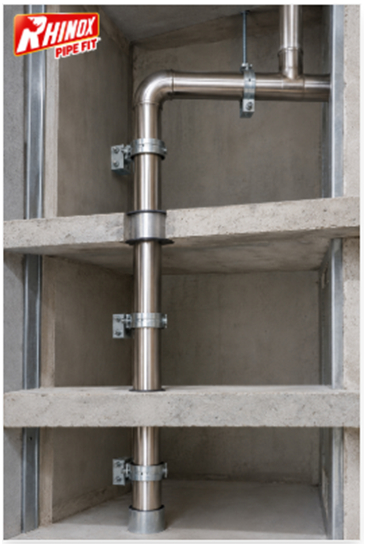
| Main building risers | Rhinox SS Pipes | High pressure rating, rigid for shaft routing, 50+ year lifespan |
| High-pressure ground zones | SS with VV-Press fittings | 25-bar rating — MLC not suitable for extreme pressure |
| In-apartment hot and cold distribution | Rhinox MLC Pipes | Flexibility eliminates fittings, faster installation, lower cost per m² |
| Underfloor heating circuits | Rhinox MLC Pipes | Oxygen barrier, flexibility for coil layout, low expansion |
| Solar thermal and heat pump circuits | Rhinox MLC Pipes | Handles up to 95°C continuously — oxygen barrier protects system |
| Concealed routing in narrow wall chases | Rhinox MLC Pipes | Hand-bendable to fit confined routing paths without fittings |
| Fire fighting wet and dry risers | SS Pipes only | MLC not rated for fire system applications — SS mandatory |
| Potable water mains — WHO / NSF compliance | SS Pipes | SS 316L carries NSF 61 and WHO certification for potable water mains |
| HVAC chilled water | MLC or SS depending on pressure zone | MLC for in-unit fan coil connections; SS for main chilled water headers |
The Rhinox Hybrid Approach: The most cost-effective and performance-optimised plumbing specification for a premium residential or commercial project uses SS 316L for main risers, high-pressure zones, and fire systems — and Rhinox MLC pipes for in-apartment distribution, underfloor heating, and all flexible concealed routing. Both systems use the same press fitting platform, the same press tool, and can be installed by the same team. This is the approach Rhinox India recommends and supports through its one-stop plumbing service.
Where Are MLC Pipes Used in India? — Application Guide
Premium Residential Apartments and Villas
In-apartment cold and hot water distribution from the apartment entry point to all bathroom and kitchen fixtures. MLC pipe's hand-bendability allows plumbers to snake pipe through narrow wall chases, under flooring, and around structural obstacles without cutting additional fittings into the run — reducing both material cost and leak risk in concealed installation scenarios that will remain inaccessible for decades.
Underfloor Heating and Radiant Floor Systems
Underfloor radiant heating is growing rapidly in premium Indian residential projects — particularly in colder northern cities like Delhi, Noida, Gurugram, Chandigarh, and Shimla. MLC pipe is the only appropriate material for underfloor heating coil circuits — its flexibility allows the pipe to be coiled at the required spacing across the floor slab, its aluminium oxygen barrier protects the boiler and pump from oxygen corrosion, and its low thermal expansion coefficient prevents the stress cracking that standard CPVC pipes experience under the repeated heating and cooling cycles of a radiant floor system.
Solar Thermal and Heat Pump Systems
Solar water heaters and heat pump systems require piping that can handle temperatures of 80–95°C on a daily cycle without degrading, cracking, or losing pressure integrity. MLC pipe's continuous working temperature of 95°C — and short-term peak tolerance of 110°C — makes it the correct specification for solar thermal collector circuits and heat pump distribution loops, where CPVC would be at or beyond its temperature limit under summer solar conditions in India.
Hotels, Resorts, and Serviced Apartments
Hospitality projects demand zero plumbing disruption after opening — a leaking pipe behind a finished hotel room wall means room downtime, guest complaints, and expensive remedial work. MLC pipe's press fit connections, bend-and-hold routing capability, and 50+ year lifespan minimise the number of joints in each room's plumbing circuit and ensure that once installed, the system requires no maintenance or inspection throughout the property's service life.
Hospitals and Healthcare Facilities
In healthcare facilities, plumbing maintenance disruption is not just a convenience issue — it is a patient safety issue. MLC pipes' combination of corrosion resistance, flexible routing, and press-fit connectivity allows hospital ward plumbing to be installed quickly with minimal disruption to adjacent clinical areas, and to remain maintenance-free for the operational life of the facility.
HVAC Fan Coil and In-Unit Chilled Water Connections
The flexible connection from rigid main chilled water headers to individual fan coil units in offices, hotels, and apartments is an ideal application for MLC pipe. The pipe's flexibility eliminates the multiple elbows that a rigid SS or copper connection to a fan coil unit would require, and its low thermal expansion minimises the stress on fan coil unit connections under the temperature cycling of HVAC operation.
Rhinox India MLC Pipes — Technical Specifications
All Rhinox India multilayer composite pipes meet the following parameters:
| Parameter | Specification |
|---|---|
| Pipe construction | PEX inner / Aluminium core / HDPE outer — 5-layer composite with adhesive bonding |
| Cross-linking method | Steam cross-linking under vacuum — uniform treatment across full coil length |
| Size range | 16mm to 63mm OD |
| Max working pressure | 10 bar at 20°C / 6 bar at 95°C |
| Continuous working temperature | Up to 95°C |
| Short-term peak temperature | Up to 110°C |
| Thermal expansion coefficient | 0.026 mm/m/°C — aluminium-controlled, much lower than pure plastic |
| Oxygen barrier | Complete — aluminium core provides total O₂ diffusion barrier |
| Inner surface | Smooth PEX bore — low friction, scale-resistant |
| Connection method | Rhinox Press fitting platform — V-Press and VV-Press compatible |
| Supply form | Coils — 50m and 100m standard lengths for smaller diameters |
| Potable water contact | Yes — PEX inner layer certified for drinking water contact |
| Standards compliance | ISO 21003, EN ISO 21003, DIN 16892 / 16893 |
Frequently Asked Questions — MLC Multilayer Composite Pipes
What is the difference between MLC pipe and CPVC pipe?
MLC (multilayer composite) pipe and CPVC pipe are both used for hot and cold water plumbing, but they differ significantly in construction, performance, and limitations. CPVC is a single-material plastic pipe rated to approximately 93°C maximum and subject to high thermal expansion, UV degradation, and brittleness with age. MLC pipe combines PEX, aluminium, and HDPE in a composite structure — providing better heat resistance (95°C continuous), dramatically lower thermal expansion, an oxygen barrier that CPVC cannot provide, hand-bendability that CPVC does not offer, and a 50+ year service life. For any hot water or heating application, MLC is the superior specification.
Can MLC pipes be used for drinking water supply?
Yes. The PEX inner layer of Rhinox MLC pipes is certified for potable water contact and does not leach harmful substances into drinking water under normal plumbing operating conditions. However, for main potable water supply risers and distribution headers — particularly in high-rise buildings where WHO and NSF 61 certification is specified — Rhinox stainless steel pipes carry the higher-level certification and are the preferred specification. MLC pipes are ideal for the in-apartment distribution stage of the potable water system. Read our complete guide on stainless steel pipes for water supply systems for the full potable water specification picture.
Can MLC pipe be used for underfloor heating in India?
Yes — MLC pipe is the correct and only appropriate specification for underfloor radiant heating circuits. The aluminium oxygen barrier prevents the oxygen ingress into the heating loop that causes corrosion of boiler heat exchangers, pump impellers, and radiator valves — the most common cause of premature heating system component failure. The pipe's flexibility allows it to be coiled at the precise spacing required for even floor heat distribution, and its low thermal expansion coefficient prevents the pipe stress that CPVC experiences under repeated heating and cooling cycles in underfloor applications.
What is the maximum temperature MLC pipe can handle?
Rhinox MLC pipes are rated for continuous operation at up to 95°C and short-term peak temperatures of up to 110°C. This covers all hot water applications in Indian residential and commercial plumbing — including geyser hot water supply (typically 55–65°C), solar thermal systems (up to 80–90°C under summer conditions), and heat pump distribution circuits. The temperature rating is determined primarily by the PEX inner layer's cross-linking specification — Rhinox's vacuum steam cross-linking process ensures consistent heat resistance across every metre of pipe produced.
What is the difference between PEX-AL-PEX and PE-RT-AL-PE-RT composite pipes?
Both PEX-AL-PEX and PE-RT-AL-PE-RT are multilayer composite pipe constructions with identical three-layer aluminium sandwich structures. The difference is in the inner layer polymer: PEX uses cross-linked polyethylene (produced through peroxide, silane, or radiation cross-linking processes), while PE-RT uses a raised-temperature-resistant polyethylene that achieves its heat resistance through controlled molecular structure rather than cross-linking. Both are certified for potable water and hot water plumbing. Rhinox India's MLC pipes use a PEX inner layer produced by steam cross-linking under vacuum — the most consistent cross-linking method available.
Do MLC pipes work with the same press tool as Rhinox SS pipe fittings?
Yes. Rhinox MLC pipes use the same Rhinox Press fitting platform as the SS pipe range — with compatible V-Press and VV-Press fittings at connection points. This means a single installation team with a single press tool can install both the SS riser and MLC distribution components of a hybrid plumbing system — eliminating the need for separate pipe and fitting systems and separate trade teams for different parts of the building. Contact Rhinox India's technical team for guidance on hybrid SS and MLC system design for your specific project.
Are MLC pipes suitable for fire fighting systems?
No. MLC pipes are not suitable for fire fighting wet or dry riser systems, sprinkler supply lines, or any piping required to maintain integrity during a fire event. Fire fighting systems must be specified in stainless steel or approved carbon steel — materials that maintain structural integrity under extreme heat. For fire system specification, use Rhinox SS pipes with VV-Press fittings — rated to 870°C structural integrity and 25 bar working pressure.
Get the Right Pipe for Every Part of Your Project
Rhinox India supplies the complete plumbing system for every part of your residential, commercial, or industrial project — from the pump room to the final fixture connection. Our technical team will help you specify the right material for each application: SS 316L where pressure, fire safety, and potable water certification demands it — MLC composite where flexibility, installation speed, and underfloor heating performance is the priority.
Explore the complete product range and find out why India's leading developers, MEP consultants, and plumbing contractors are choosing Rhinox as their single-source plumbing system partner: MLC Pipes — SS Pipes — V-Press Fittings — VV-Press Fittings — Brass Fittings — System Comparison
Toll Free: 1800-120-6232
Email: contact@rhinoxindia.com
Technical Support: rhinoxindia.com/support
Office: 524, Phase-5, Udyog Vihar, Sector-19, Gurugram – 122008, Haryana, India