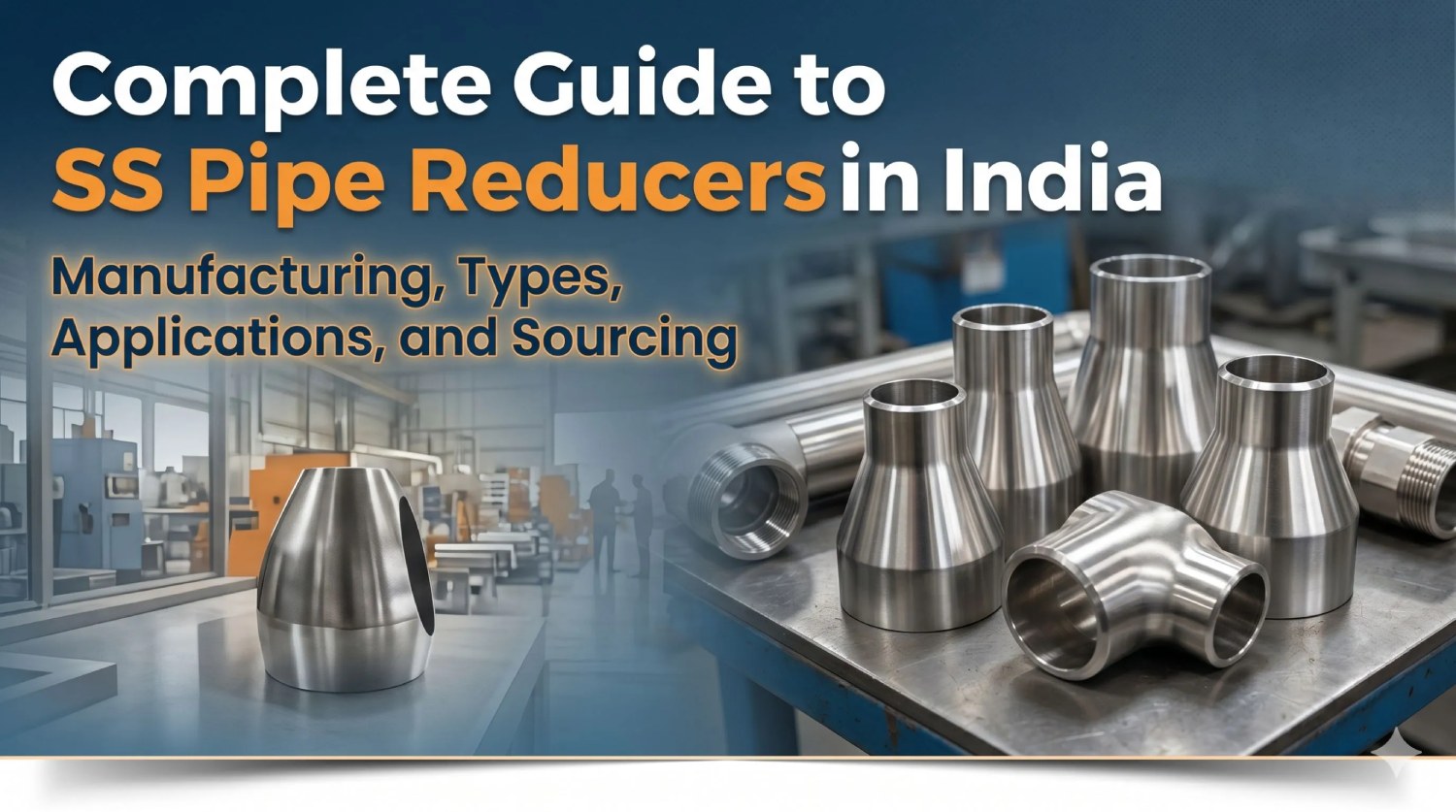
Whether you are building a new residential complex in Mumbai, installing a commercial chiller system in Bangalore, or upgrading an industrial facility in Pune, one fitting keeps coming up in every pipeline design: the SS pipe reducer. It is small, understated, and routinely underestimated—yet it is responsible for controlling flow, maintaining pressure balance, and connecting piping systems of different diameters cleanly and safely.
This guide covers everything a specifier, plumber, contractor, or facilities manager needs to know about stainless steel pipe reducers in India—what they are, how they work, the different types, materials, grades, Indian standards, installation best practices, and how to source the right product for your application.
| Rhinox India manufactures a full range of SS pipe fittings—including reducers—using Grade 316L stainless steel, backed by American precision technology and tested to meet international hydraulic and eddy-current standards. |
1. What Is an SS Pipe Reducer?
A stainless steel pipe reducer is a pipe fitting that connects two pipes of different diameters. It transitions the flow path from a larger bore to a smaller bore (or vice versa) without creating turbulence, pressure drop, or leak points. In any plumbing or process piping system, reducers are as essential as elbows and tees—they make the entire network modular and adaptable.
In India's infrastructure landscape—from smart-city water distribution networks to hospital HVAC systems—reducers are among the most-specified fittings in engineering drawings. Choosing the wrong reducer, however, can result in water hammer, excessive noise, joint failure, or long-term corrosion. Choosing the right one, made from the right grade of SS with the right jointing method, pays dividends over decades.
2. Types of SS Pipe Reducers
2.1 Concentric Reducers
In a concentric reducer, both the large and small ends share the same central axis. This makes them ideal for vertical piping runs and systems where the centreline must be maintained, such as vertical water supply risers in multi-storey buildings or process pipelines where alignment matters. They are the most common type specified in Indian residential and commercial projects.
2.2 Eccentric Reducers
An eccentric reducer keeps one side flat (the flat side is placed on top or bottom depending on the application) while the other side steps down in diameter. This design prevents air pockets in horizontal pipelines—making them the preferred choice for pump suction lines, HVAC chilled water systems, and food-processing facilities. When you need to maintain a consistent invert level (bottom of the pipe), specify an eccentric reducer.
2.3 Press-Fit Reducers
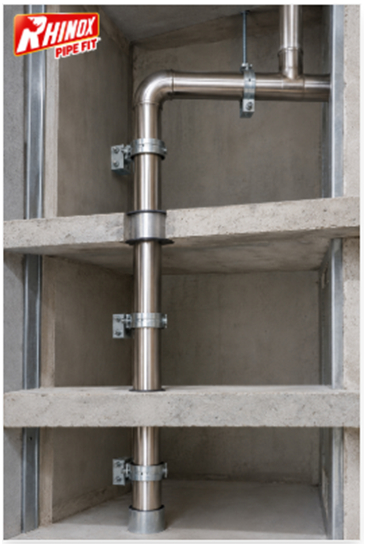
Press-fit reducers represent the most advanced jointing technology available in India today. Rhinox's Double Press and Triple VV-Press fittings eliminate the need for open-flame welding or soldering. A hydraulic pressing tool crimps the fitting onto the pipe in seconds, forming a permanent, leak-proof joint that complies with international standards. This is particularly valuable in concealed installations—inside concrete walls or under slabs—where future access is impossible.
2.4 Butt-Weld Reducers
Used in heavy industrial applications—power plants, chemical processing, oil and gas—butt-weld reducers are welded directly to the pipe ends. They conform to ASME B16.9 and are manufactured from seamless or welded SS tube stock. While they provide the highest pressure rating and are preferred for extreme temperature applications, they require certified welders and more installation time than press systems.
2.5 Threaded and Socket-Weld Reducers
For smaller diameter lines (typically up to DN50) in instrumentation, compressed air, or utility systems, threaded and socket-weld reducers offer a compact, cost-effective solution. Rhinox's 316L fittings in this category are NSF-certified lead-free, making them suitable for potable water lines in hospitals and food facilities.
3. Stainless Steel Grades: 304 vs 316L
Material selection is one of the most consequential decisions when specifying SS pipe reducers in India. The two most common grades are:
| Grade 316L is the industry benchmark for plumbing and process piping in India—recommended by Rhinox for all potable water, HVAC, and corrosive-environment applications. |
- SS 304 (1.4301): Contains 18% chromium and 8% nickel. Excellent general corrosion resistance. Widely used in interior plumbing, food service, and architectural applications where chloride exposure is minimal.
- SS 316L (1.4404): Contains an additional 2–3% molybdenum, which dramatically improves resistance to chloride-induced pitting and crevice corrosion. The 'L' denotes low carbon content (≤0.03%), which prevents carbide precipitation during welding and extends service life in aggressive environments.
- SS 316Ti (Titanium-stabilised): Rhinox's 316L pipes include titanium stabilisation, which protects the grain boundary structure at temperatures above 800°C—critical for solar thermal and industrial steam applications.
In coastal Indian cities like Chennai, Mumbai, and Vizag—where groundwater and ambient air carry elevated chloride concentrations—specifying 316L over 304 is not optional; it is a matter of system longevity.
4. Indian Standards and International Certifications
When procuring SS pipe reducers in India, buyers should verify compliance with relevant standards:
- IS 1239 / IS 3589: Indian Standards for steel pipes and fittings used in plumbing systems.
- ASME B16.9: Covers factory-made wrought butt-welding fittings including concentric and eccentric reducers—the globally recognised standard for dimensions and tolerances.
- ASTM A403 / A182: American standards for wrought SS pipe fittings and forged SS fittings respectively—widely adopted by Indian project specifiers for industrial work.
- NSF/ANSI 61: Certifies that fittings, including reducers, are safe for contact with drinking water—mandatory for hospital, school, and municipal projects.
- EN 10312 / DIN 2353: European standards applicable to press-fit stainless steel systems including Rhinox's VV-press range.
Rhinox India subjects every reducer and fitting to hydraulic pressure testing, eddy current testing, and solution annealing before despatch—processes that go well beyond what many domestic suppliers offer. Learn more on the Rhinox overview page.
5. Key Applications of SS Pipe Reducers in India
5.1 Residential and Commercial Plumbing
In modern residential towers—where bathroom and kitchen supply lines branch off from larger riser pipes—reducers bridge the size gap cleanly. When combined with Rhinox SS press fittings, the entire assembly is flame-free, fast to install, and concealment-ready. Contractors report installation time savings of up to 50% compared to traditional welding.
5.2 Firefighting Systems
Reducers are a critical component of sprinkler and hydrant systems, connecting branch lines to mains and standpipes to distribution headers. SS reducers' corrosion resistance ensures the system stays functional even after years of static water contact. See Rhinox's detailed article on SS pipes and fittings for firefighting systems for technical guidance on specifying the right fitting type.
5.3 HVAC and Chilled Water Systems
In large commercial HVAC systems, eccentric reducers are routinely used on pump suction lines to eliminate air binding. The tight dimensional tolerances of press-fit 316L reducers ensure that thermal expansion and contraction—common in Indian climates with wide temperature swings—do not compromise joint integrity.
5.4 Industrial and Process Piping
Pharmaceutical cleanrooms, chemical plants, and food-processing facilities demand hygienic reducers with smooth internal surfaces that resist biofilm formation. Rhinox's electropolished 316L fittings meet these requirements while being simpler to clean than threaded alternatives.
5.5 Solar and Hot Water Systems
India's booming rooftop solar water heater market creates demand for reducers that tolerate elevated temperatures and pressures. Rhinox's heat-resistant SS piping solutions are rated for sustained service at up to 120°C, well within the operating envelope of evacuated-tube solar collectors.
6. Sizing and Selection Guide
Selecting the right reducer requires matching three parameters:
- Pipe OD and wall schedule: Rhinox SS pipes range from 12 mm to 54 mm in press-fit configurations. Butt-weld and threaded reducers extend to larger diameters. Always match the reducer's bore to the exact OD of the pipe being used—not the nominal bore, which can differ by system.
- Pressure rating: Verify that the reducer's rated working pressure exceeds the system's maximum operating pressure, including water hammer spikes. Rhinox press-fit reducers are rated for the same pressure class as the adjoining pipe.
- Flow velocity: As the bore reduces, fluid velocity increases. For domestic supply lines, target velocities below 2 m/s. For HVAC chilled water, velocities up to 3 m/s are generally acceptable.
| Rule of thumb: If you are reducing by more than two pipe sizes in a single step, consult Rhinox's technical support team (1800-120-6232) to check for cavitation risk or excessive pressure drop in the system. |
7. Installation Best Practices for Press-Fit Reducers
Rhinox's VV-Press and Double-Press systems feature a patented O-ring geometry that creates five press points, forming a joint stronger than the pipe itself. Follow these steps for a correct installation:
- Cut the pipe square using a pipe cutter or fine-tooth saw—never an abrasive cut-off wheel or oxy-acetylene torch.
- Deburr both the internal and external pipe end to prevent O-ring damage during insertion.
- Mark the insertion depth on the pipe with a permanent marker. The pipe must reach the tube stop inside the reducer for the joint to press correctly.
- Insert the pipe fully into the reducer until it reaches the tube stop. Confirm the insertion mark is flush with the fitting end.
- Position the calibrated pressing jaw—Rhinox's unique 2 U-shaped slot jaw guides itself exactly onto the fitting bead.
- Initiate pressing for approximately 3 seconds until the tool completes its automatic cycle. Do not interrupt mid-press.
- Inspect the pressed bead visually. The O-ring bead should be uniformly compressed around the full circumference.
Rhinox provides onsite installation training and a fully interactive training centre for contractors and specifiers. Technical support is available 24/7.
8. Maintenance and Longevity
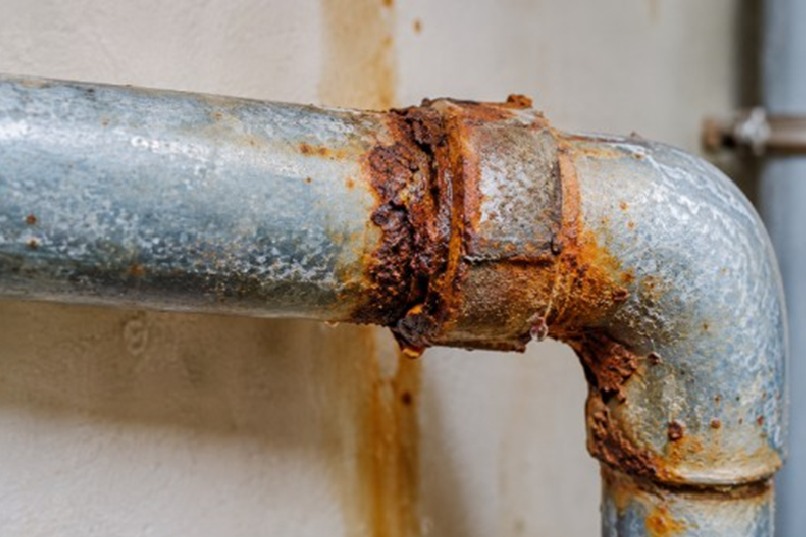
One of the defining advantages of SS pipe reducers—particularly in the 316L grade—is their extremely low maintenance requirement. Unlike galvanised iron reducers, which corrode from the inside out and require periodic replacement, stainless steel reducers installed correctly will outlast the building they serve.
Rhinox's press-fit joints are tamper-evident and permanent: once pressed, the joint cannot be undone without cutting, which ensures building owners can detect any unauthorised interference in concealed installations.
Stainless steel is also fully recyclable at end of life, contributing to green building ratings under IGBC and LEED India frameworks. For a deeper look at why SS plumbing is India's sustainable infrastructure choice, read Rhinox's guide on SS pipes for modern Indian buildings.
9. Comparing SS Reducers to Alternative Materials
| Parameter | SS 316L | Galvanised Iron | CPVC | Copper |
| Corrosion resistance | Excellent | Poor | Good | Moderate |
| Temperature rating | Up to 120°C | Up to 80°C | Up to 93°C | Up to 100°C |
| Hygienic safety | NSF-certified | Risk of rust | Chemical leach risk | Good |
| Installation speed | Very fast (press) | Slow (threading) | Moderate | Slow (brazing) |
| Lifespan (years) | 50+ | 15–25 | 20–30 | 30–40 |
| Recyclability | 100% | Partial | No | High |
10. Procurement in India: What to Look for
The Indian market for SS pipe fittings has grown substantially in the past decade, but quality varies widely. When sourcing reducers, verify the following before placing an order:
- Declared material grade: Insist on mill test certificates (MTC) confirming 316L or 304 composition. Reject fittings sold only as 'stainless steel' without grade documentation.
- Testing evidence: Ask for hydraulic pressure test reports and, for critical applications, eddy current test data. Rhinox tests every fitting individually.
- O-ring specification (for press-fit): Confirm whether the O-ring is EPDM (black, for water up to 110°C), HNBR (yellow, for gas), or FPM (green, for chemical applications).
- Country of origin and brand authenticity: Rhinox India is a globally recognised brand headquartered operationally in Washington, USA, with manufacturing that meets American precision standards. Counterfeit or unbranded fittings sold at unusually low prices carry significant risk in concealed installations.
To get product specifications, bulk pricing, and technical data sheets, contact Rhinox at rhinoxindia.com or call the free helpline: 1800-120-6232.
11. Frequently Asked Questions
What is the maximum working pressure for Rhinox SS press-fit reducers?
Rhinox's press-fit system is rated for continuous working pressures consistent with the SS pipe schedule being used. The tensile strength of Rhinox 316L pipe exceeds 520 N/mm², and the stainless steel-to-water joint pull-out strength is rated above 520 N/mm². Always consult Rhinox's technical team for project-specific pressure confirmation.
Can SS reducers be used in concealed or underground installations?
Yes. Press-fit reducers are specifically designed and recommended for concealed locations—behind walls, beneath slabs, and underground (with PE coating where required). The permanent, tamper-evident joint means no ongoing maintenance access is needed.
Is SS 316L safe for drinking water in India?
Absolutely. Rhinox 316L fittings are manufactured to be lead-free and conform to NSF/ANSI 61 principles. Stainless steel is inert—it does not leach chemicals into water, unlike certain plastics or older copper-lead soldered joints.
How do I choose between a concentric and eccentric reducer?
Use a concentric reducer for vertical runs and where centreline alignment is required. Use an eccentric reducer for horizontal runs—particularly on pump suction inlets—to prevent air pockets and ensure proper drainage when the system is shut down.
What pressing tools are compatible with Rhinox reducers?
Rhinox's VV-press system uses a calibrated pressing jaw with a patented 2 U-shaped slot design that self-positions on the fitting bead. Compatible pressing tools are available through Rhinox's distribution network. For installation guidance, visit the Rhinox support centre.
Conclusion: The Right Reducer Makes the Difference
An SS pipe reducer is not a commodity item—it is a precision engineering component whose quality directly affects the safety, longevity, and hygiene of every pipeline it joins. In India's rapidly expanding construction sector, specifying the right reducer—made from verified 316L stainless steel, tested to international standards, and installed using modern press-fit technology—is the difference between a plumbing system that delivers clean water for 50 years and one that demands costly repairs within a decade.
Rhinox India offers the complete package: premium SS pipes, press fittings, reducers, and the technical expertise to back them—from specification to installation to after-sales support. Explore the full product range at rhinoxindia.com or reach the team at 1800-120-6232.