A pipe cut to length at 25°C is not the same length at 70°C. In a hot water riser, that difference shows up as bowed pipe, noisy clips and stressed joints. Thermal expansion in plumbing pipes is predictable, which means it can be designed for.
This guide explains how much pipes move, how to calculate it, and which layouts and devices keep movement under control.
Quick Answer: Thermal expansion in plumbing pipes is the change in pipe length as temperature rises and falls. Calculate it with ΔL = α × L × ΔT. Manage it with fixed points, guides, offsets, loops or expansion joints, placed so the pipe can move where you want it to. Requirements vary by pipe material, temperature range, layout and manufacturer specifications.
What Is Thermal Expansion in Plumbing Pipes?
Thermal expansion is the growth of a pipe when it heats up and the shrinkage when it cools. The change is small per metre but adds up over long runs, and a pipe held rigidly at both ends pushes hard on whatever restrains it. The Copper Development Association notes that all piping materials expand and contract, and that a long line may buckle if the system has no compensation built in (Copper Tube Handbook). Pipe expansion and contraction also happens on cold lines, driven by sun, rain and seasons.
Where movement shows up first
- Long hot water risers in service shafts
- Terrace and rooftop runs exposed to sun and rain
- Pipes passing through slab sleeves and walls
How Do You Calculate Thermal Expansion in Water Pipes?
Use ΔL = α × L × ΔT. Here α is the material's expansion coefficient, L is the pipe length between fixed points, and ΔT is the difference between the lowest and highest pipe temperature. For thermal expansion in water pipes, use the full range the pipe will see, including cold nights and idle periods, not only the hot water set point.
As an example, take a 20 m run heated from 20°C to 70°C, so ΔT is 50°C.
| Material | Typical α (mm/m·°C) | Movement over 20 m |
| Carbon steel | about 0.012 | about 12 mm |
| Copper | about 0.017 | about 17 mm |
| Stainless steel 316L (austenitic) | about 0.017 | about 17 mm |
| Rhinox MLC (PERT-Al-PERT) | 0.025 (Rhinox published) | about 25 mm |
| Unreinforced plastic pipes | several times higher | use the maker's value |
The Australian Stainless Steel Development Association lists about 17 µm/m·°C for austenitic stainless steel against 12 for carbon steel (ASSDA technical FAQ). Plastics expand several times more than metals, as the Plastic Pipe and Fittings Association explains. Values here are typical, so confirm them for your grade and temperature range.
Which Plumbing Systems Need Expansion Compensation?
Systems with long runs, large temperature swings and rigid restraint need it most. Typical cases are hot water risers, recirculation loops, solar thermal lines, exposed terrace pipework and tall buildings. Short branches with several bends often absorb movement naturally. Whether compensation is required depends on material, temperature range, layout and the manufacturer's installation guidance, so check each run instead of assuming.
Screening questions for each run
- What are the lowest and highest pipe temperatures in service?
- How long is the run between fixed points?
- Can existing bends or offsets absorb the movement?
- Is the pipe free to slide in clips and sleeves?
- Does the manufacturer's manual set limits for this system?
How Do Fixed Points, Guides and Loops Work Together?
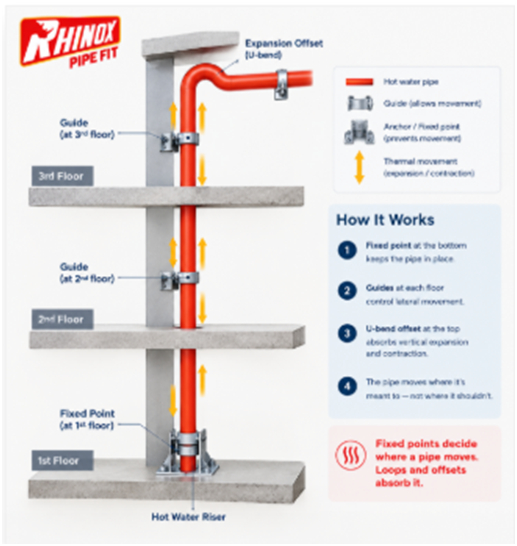
Fixed points decide where a pipe stays put, guides keep it aligned, and loops or offsets absorb the movement. The Copper Tube Handbook lists offsets, U-bends, coil loops and expansion joints as the usual ways to take up movement without excessive stress. Anchoring a straight run near its middle can split the movement towards both ends. Guides then stop the pipe from buckling between anchors.
Placement rules to check on drawings
- Mark every fixed point and guide on the plumbing drawings
- Send movement towards a loop, offset or flexible bend
- Size slab sleeves so the pipe slides freely
- Keep insulation from locking the pipe to the structure
- Avoid rigid clamps at both ends of a straight run
When Do Plumbing Pipe Expansion Joints Make Sense?
Plumbing pipe expansion joints suit places where there is no room for a loop or offset, such as a crowded shaft. Common types include axial compensators, slip joints and flexible connectors. Each needs a correctly placed fixed point and guide, and the structure must carry the loads they create. Choose joints rated for the pipe's pressure, temperature and material, and follow the joint maker's installation instructions.
How Does Pipe Material Change the Expansion Plan?
Material sets how far a pipe moves and how hard it pushes. Metals move less but resist harder. Reinforced and plain plastics move more but flex easily. Rhinox stainless steel pipes are EN 1.4404 (316L), DN15 to DN100, so plan loops, offsets and guides as for any rigid metal pipe. Rhinox MLC pipes are five-layer PERT-Al-PERT pipes from 16 mm to 75 mm, rated up to 95°C and 10 bar. Their aluminium layer lowers expansion (Rhinox publishes 0.025 mm/m·K), and they bend easily, so layout bends can absorb movement.
Press joints give a permanent connection, and they are not movement devices. Triple (VV) press fittings, Double (V) press fittings and brass press fittings hold the joint, and the pipe layout handles the movement. Many projects mix both pipe types. See the stainless steel tubes guide, the guide to brass press fittings for MLC pipes and the system comparison.
What Should Specifiers Check Before Finalising a Layout?
Calculate movement for each riser and long branch, then place anchors, guides and compensation to suit. Confirm pipe, fitting and seal ratings at the highest temperature. Coordinate with the structure, since slabs, sleeves and shafts decide what is possible. Ask the manufacturer for its installation manual and support guidance, because spacing and limits differ by system. Rhinox offers technical support and free circuit design assistance through its support team and one-stop service.
Pre-specification checklist
- Calculate movement for every riser and long branch
- Mark fixed points, guides and compensation on drawings
- Confirm ratings at maximum temperature and pressure
- Size sleeves and insulation to allow free movement
- Request the manufacturer's installation manual
Read the high-rise plumbing guide and the heat-resistant pipes guide for related design points.
Frequently Asked Questions
Do plumbing pipes expand and contract?
Yes. All piping materials grow when heated and shrink when cooled. The amount depends on material, length and temperature change.
How much does a pipe expand with heat?
Multiply the expansion coefficient by length and temperature change. A 20 m stainless steel run heated by 50°C grows about 17 mm, using roughly 17 µm/m·°C.
Do stainless steel pipes expand?
Yes. Austenitic stainless steel expands more than carbon steel, at roughly 17 µm/m·°C versus 12, and about the same as copper.
Do hot water pipes need expansion loops?
Long runs with large temperature swings usually need some compensation. Short runs with bends may not. Check material, layout and manufacturer guidance.
What are expansion joints in plumbing?
They are devices, such as axial compensators or slip joints, that absorb pipe movement. They need correct fixed points, guides and suitable pressure and temperature ratings.
How do you manage pipe movement in a high-rise building?
Calculate movement per riser, set fixed points and guides on each design, and use offsets, loops or joints where needed. Follow the manufacturer's manual.
Plan Pipe Movement Before the Pipes Go In
Pipe movement is easy to design for and costly to fix behind a finished wall. Calculate it, place fixed points and guides deliberately, and match the compensation method to the material and layout. Talk to Rhinox's technical team about your riser layout, temperatures and pipe material.
Explore the range: SS Pipes - MLC Pipes - V-Press Fittings - VV-Press Fittings - Rhinox Press System